orma — crafting with intelligence
a unified AI workspace for the entire UX/UI design process — built for researchers, designers, developers, and product managers to work as one.

TL;DR
Designers today juggle a dozen disconnected AI tools across their workflow. I interviewed 6 UX/UI designers and audited 11 AI platforms, then designed Orma: a unified workspace where tailored AI tools support all six phases of the UX/UI design process — from research to post-launch — in a single, collaborative flow.
Problem
AI is transforming how designers work — but the tooling landscape is fragmented. A designer might use ChatGPT for personas, Maze for testing, Uizard for wireframes, Khroma for color, and Amplitude for analytics. Every switch between tools breaks focus, scatters project data, and makes collaboration harder. My thesis research question: How do UX/UI designers incorporate AI tools into their workflows — and what are the benefits, challenges, and levels of trust associated with these tools? The answer to that question became the design brief for Orma.
Solution
Orma — from the Italian word for footprint or trace — is a unified AI platform structured around the six phases of the UX/UI design process: Research & Discovery Information Architecture Wireframe & Prototype Visual Design Development Handoff Launch & Post-Launch Each phase is a dedicated workspace with AI tools tailored to that stage's needs — so researchers, designers, PMs, and developers move through a project together without leaving the platform.
The Research Behind Orma
Interview | Competitive Analysis |
|---|---|
6 UX/UI designers interviewed | 11 AI-powered platforms |
The pattern: each tool is strong in one phase and blind to the rest. The workflow fragmentation designers complained about was structural — not a training problem.
Designers don’t need more AI tools. They need their AI tools to live where the work happens — connected across phases, transparent about progress, and always leaving the final decision to the human.
The platform system: Architecture and AI
Orma's interface is the visible layer of a larger system. Three views explain it: how the work is structured, how the AI is organized, and how work moves between phases.
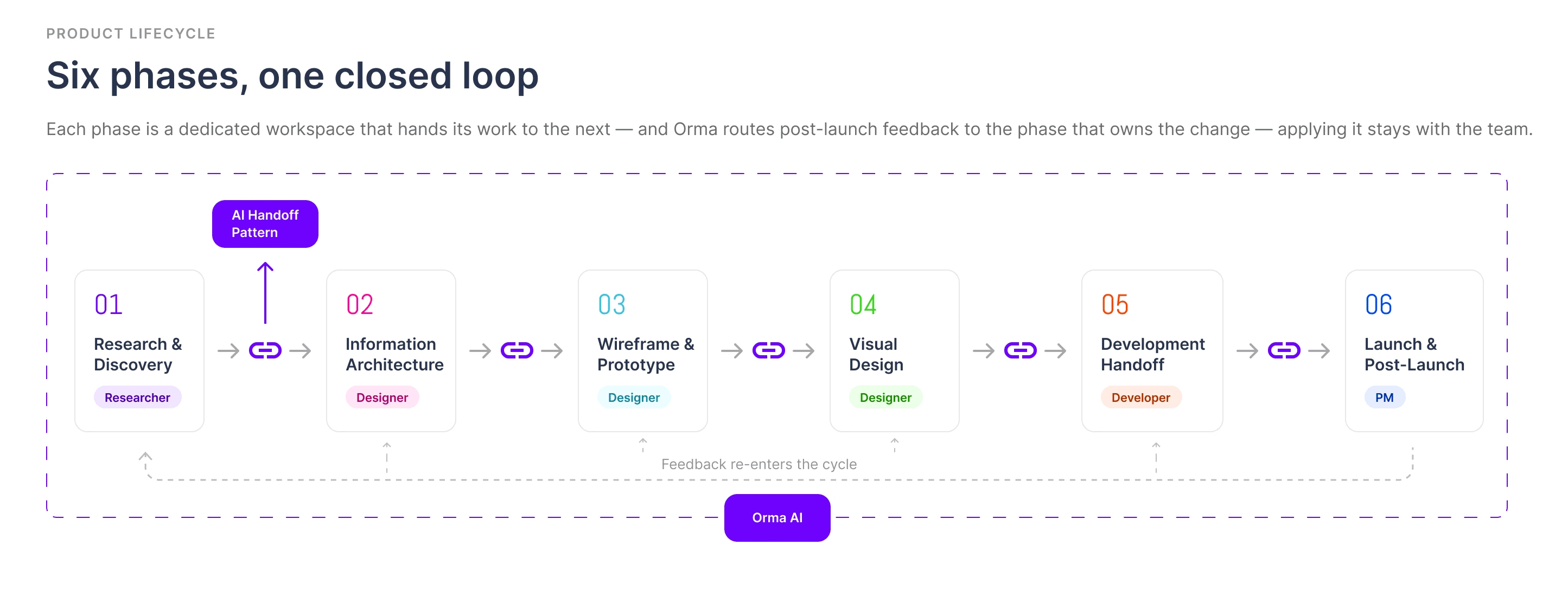
A design project today scatters across research repositories, whiteboards, design files, and ticketing systems — and context gets lost at every export between them. Orma's answer is structural: the entire lifecycle lives inside one platform, so work never leaves the system it was created in. The structure mirrors the methodology — navigating the product means moving through the process itself. And launch isn't an endpoint: Orma routes post-launch feedback to the phase that owns the change — nothing is applied until the team accepts it, so the loop improves the live product without ever restarting the process.
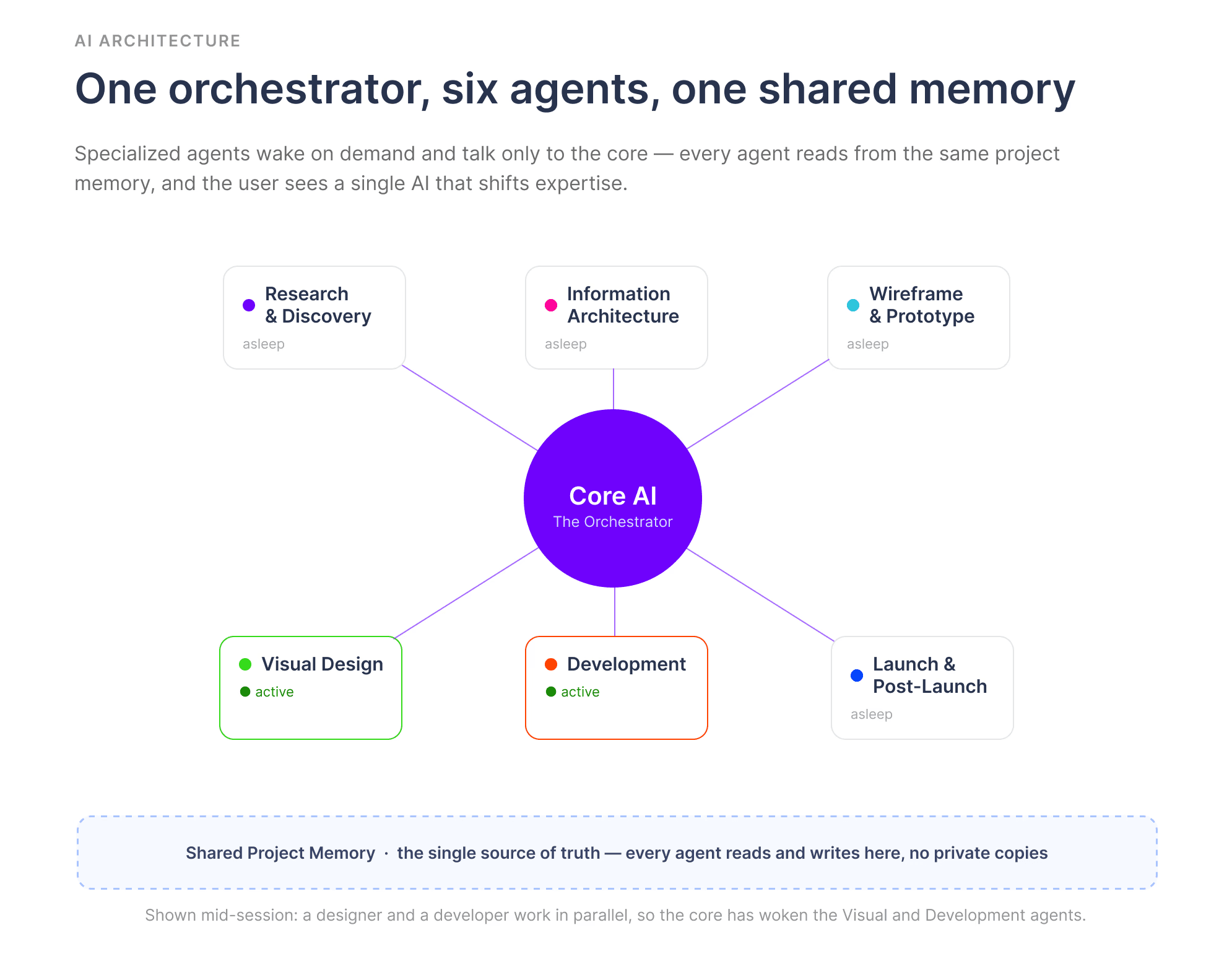
Why not a single general assistant? Because the work changes shape at every phase — synthesizing research has little in common with generating design tokens or writing handoff specs. Specialization keeps each agent's scope narrow and its behavior easy to inspect, while the shared memory solves the deeper problem: a decision made in Research is still there, with its reasoning, when Development needs it months later. And routing everything through one core keeps the system accountable — there is always exactly one place that knows what the AI is doing, and why.
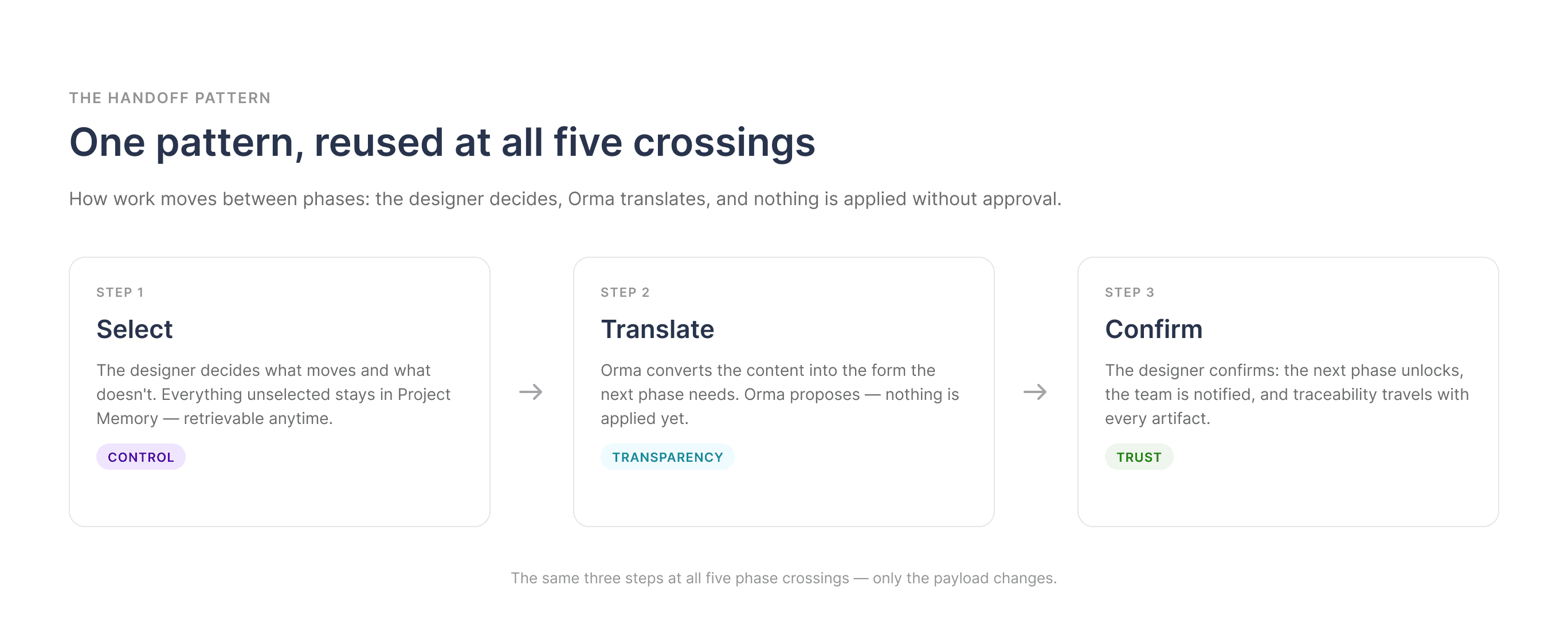
This pattern is where my research became design. Throughout my thesis, the same three barriers to AI adoption kept surfacing: designers don't trust what they can't see, and won't adopt what they can't control. The handoff answers each barrier — selection gives control, translation-before-application gives transparency, confirmation builds trust. And the pattern itself is AI: Orma reads both sides of the crossing — the phase the content comes from and the phase it's going to — and prepares the transfer from both contexts; the designer stays the one who approves. Just as important is the repetition: because the identical contract applies at all five crossings, designers only learn it once, and the AI's behavior stays predictable everywhere in the platform.
Inside Orma
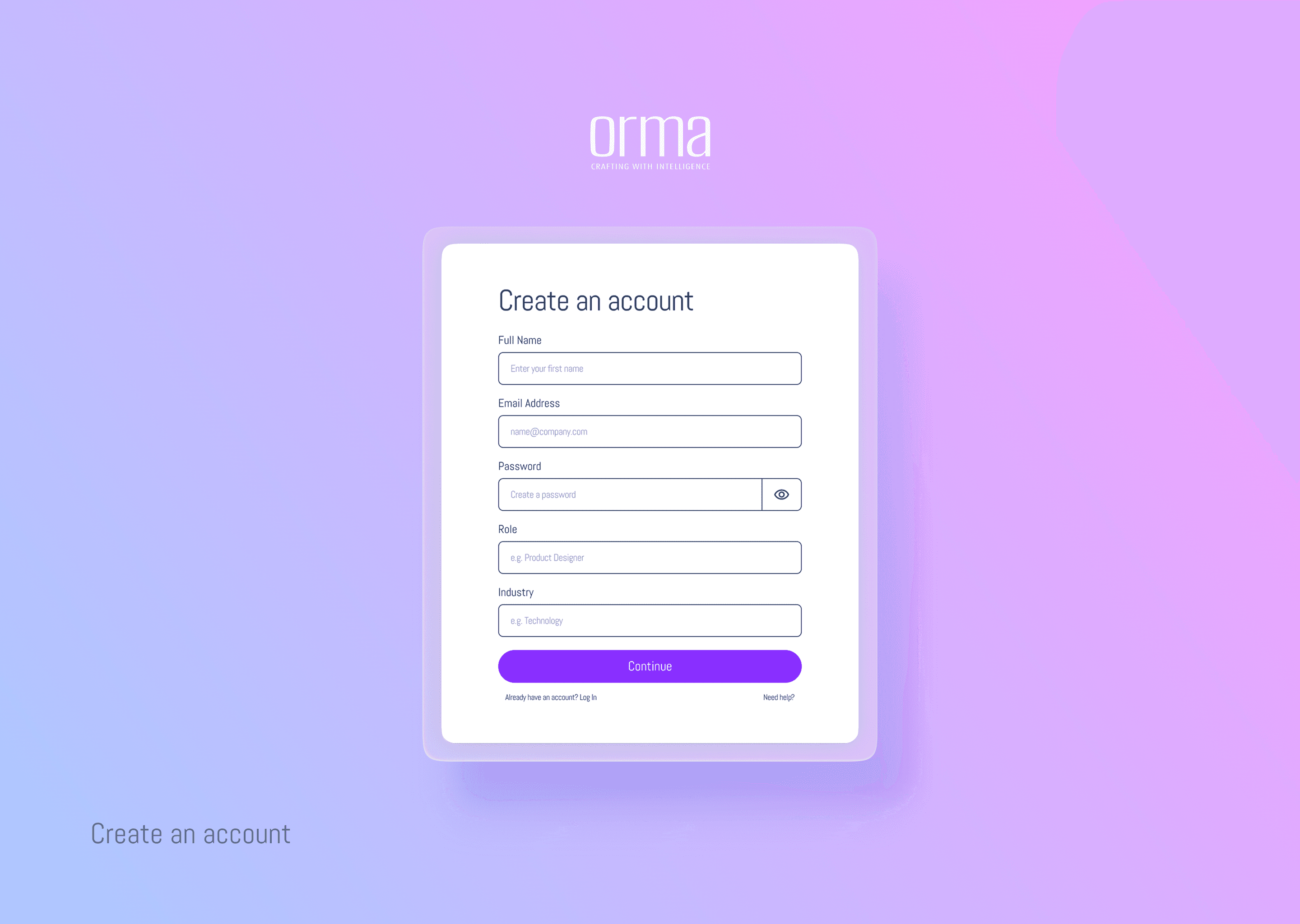
One form stands between the user and the platform — and every field earns its place. Name, email, and password create the account; role and industry give Orma its first context: this is what lets the AI adapt its assistance to each user from the very first session. Your team arrives with the project — when you create one, you invite the people you'll work with.
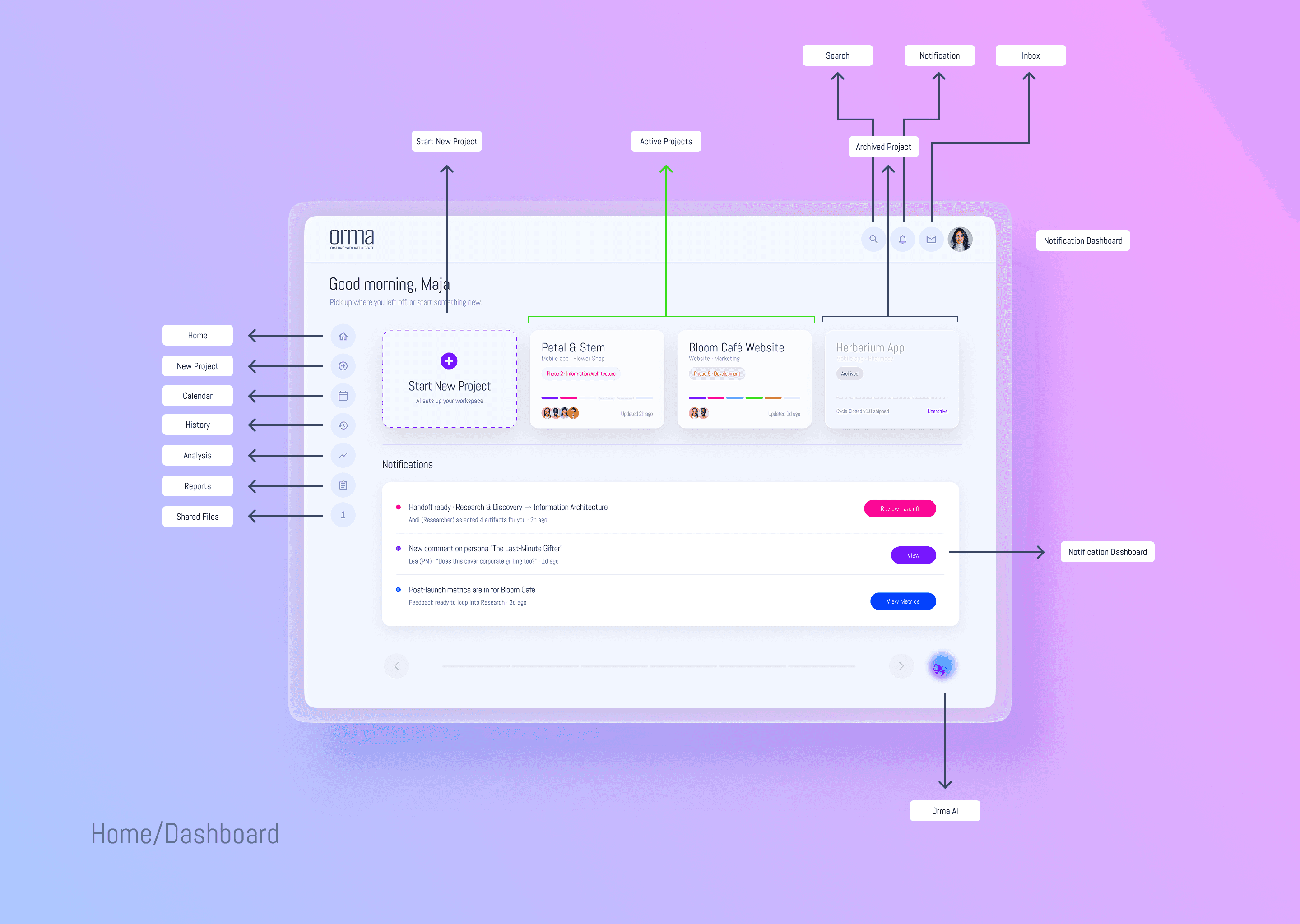
Sign-up lands here: every project at a glance, each card carrying its current phase and its position on the six-color lifecycle bar. The notifications below are the system's concepts surfacing as daily work — a researcher's handoff waiting for review, a teammate's comment on a persona, post-launch metrics ready to loop back in. Each one is an invitation, never an action already taken: Orma informs, the user decides. And a new project is a single card away.
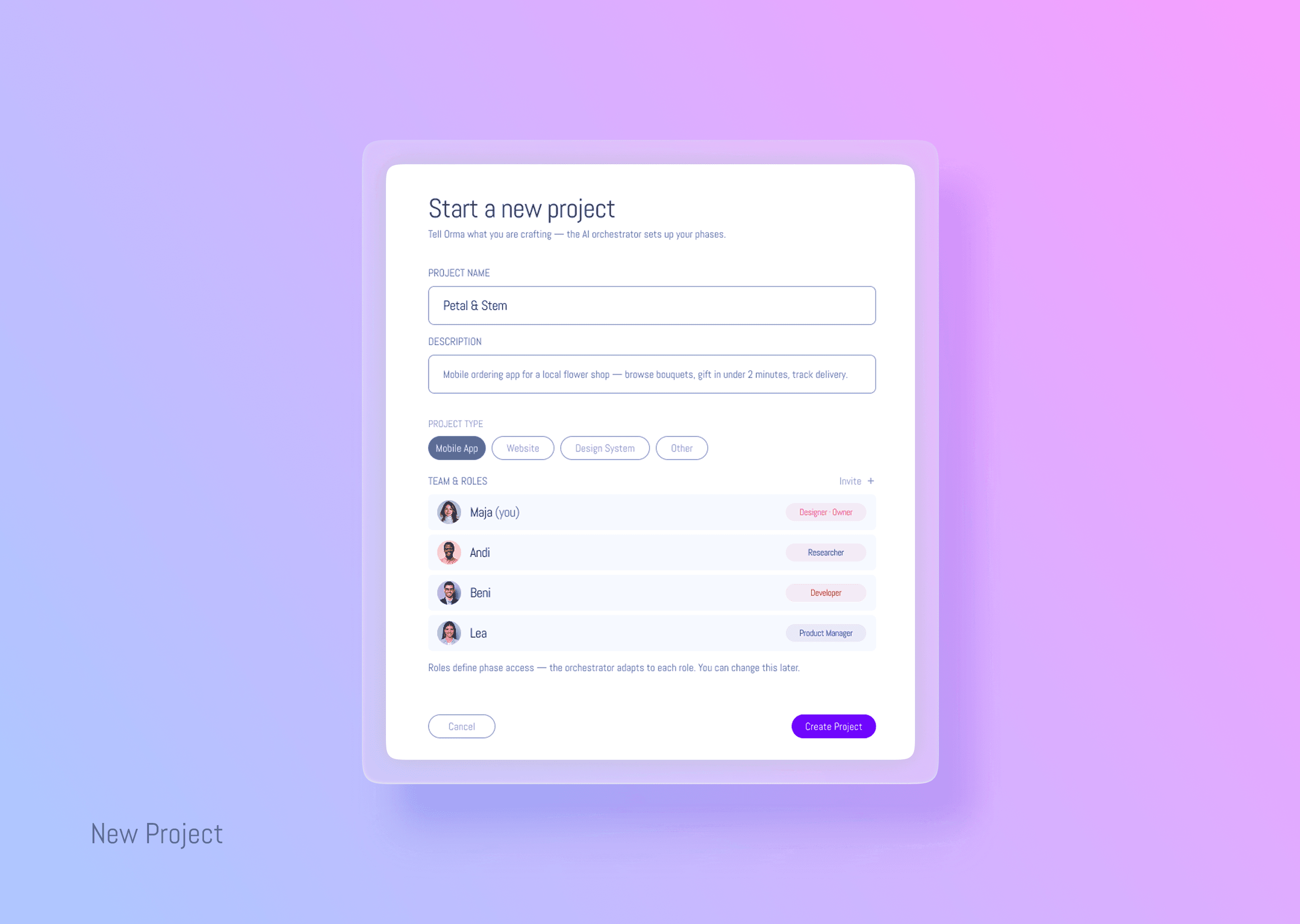
Creating a project is the user's work, not the AI's: name it, describe what you're crafting, pick the type, invite the team and assign their roles. Only then does Orma act — taking what you defined and setting up the six phases around it. The roles matter most: they define phase access, and the orchestrator adapts to each one — Andi the researcher, Beni the developer, and Lea the PM will each meet a different Orma. Nothing is configured that the user didn't state.
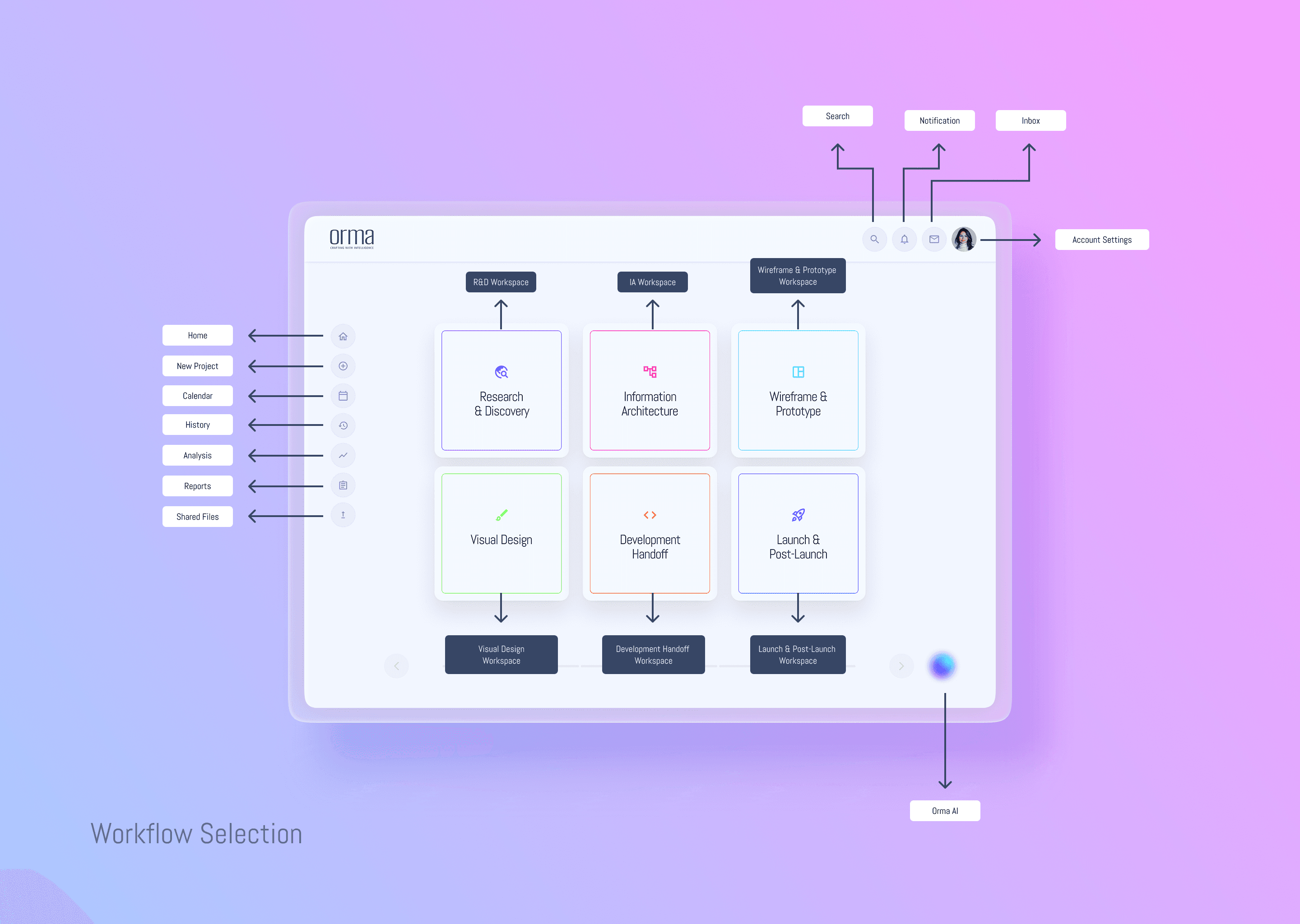
Every new project opens here: the six phases of the lifecycle, each a dedicated workspace, each carrying its phase color. The designer enters the work by choosing a phase — not by hunting through files — because in Orma, the structure is the navigation. Global tools sit in the sidebar, and the Orma AI waits in the corner of every screen.
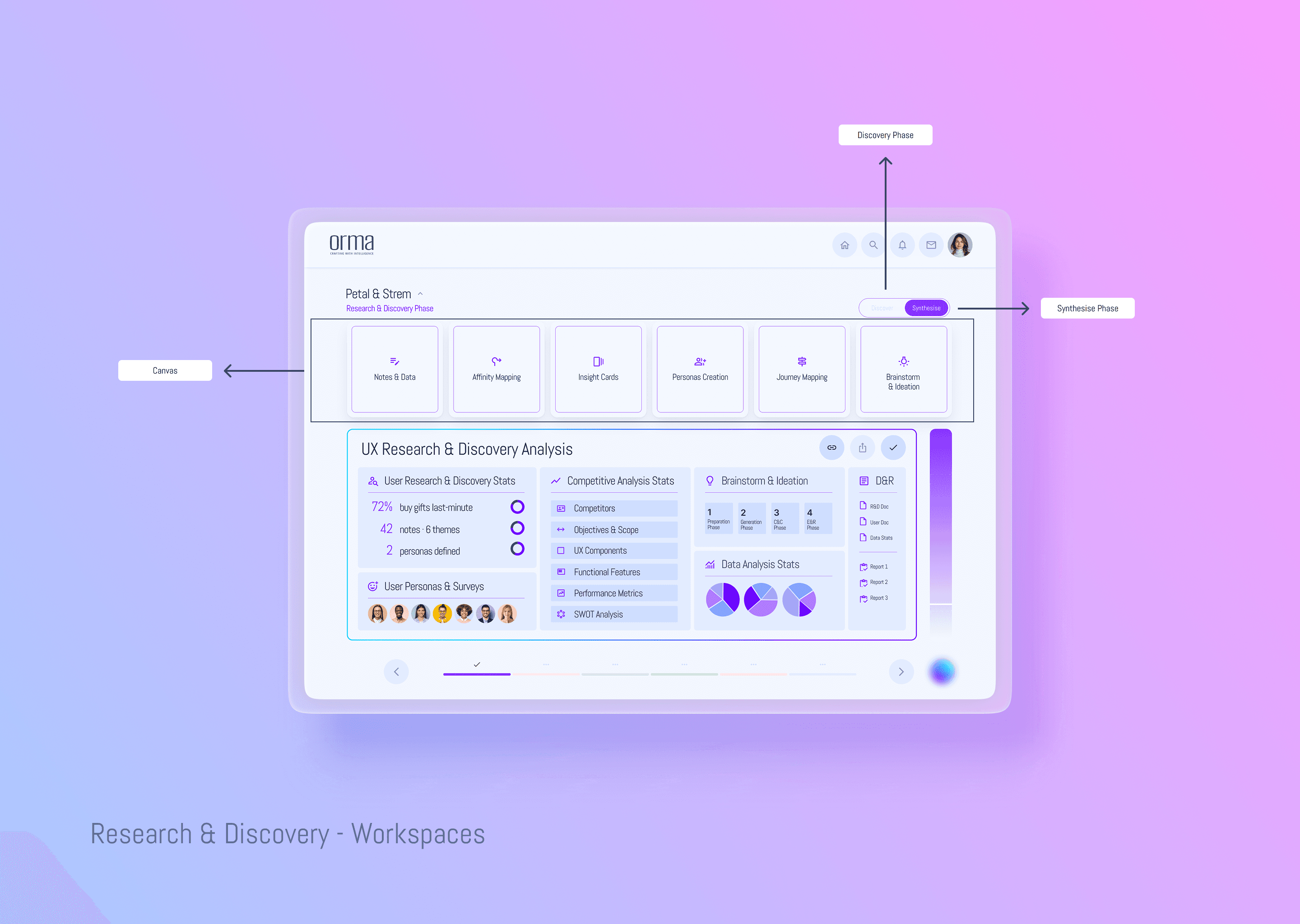
Inside a phase — here, Research & Discovery for the sample project Petal & Stem. One toggle switches the workspace between its two working modes: Discover, where the research happens, and Synthesise, where it comes together. The work itself lives in canvases, one per method designers already know — notes, affinity mapping, insight cards, personas, journey mapping, ideation — each card opening a dedicated space, because adoption starts with familiar vocabulary. Everything else is answered at a glance, without opening a single canvas: the Orma AI Analysis panel, kept live by the Research agent, gathers the state of the whole phase.
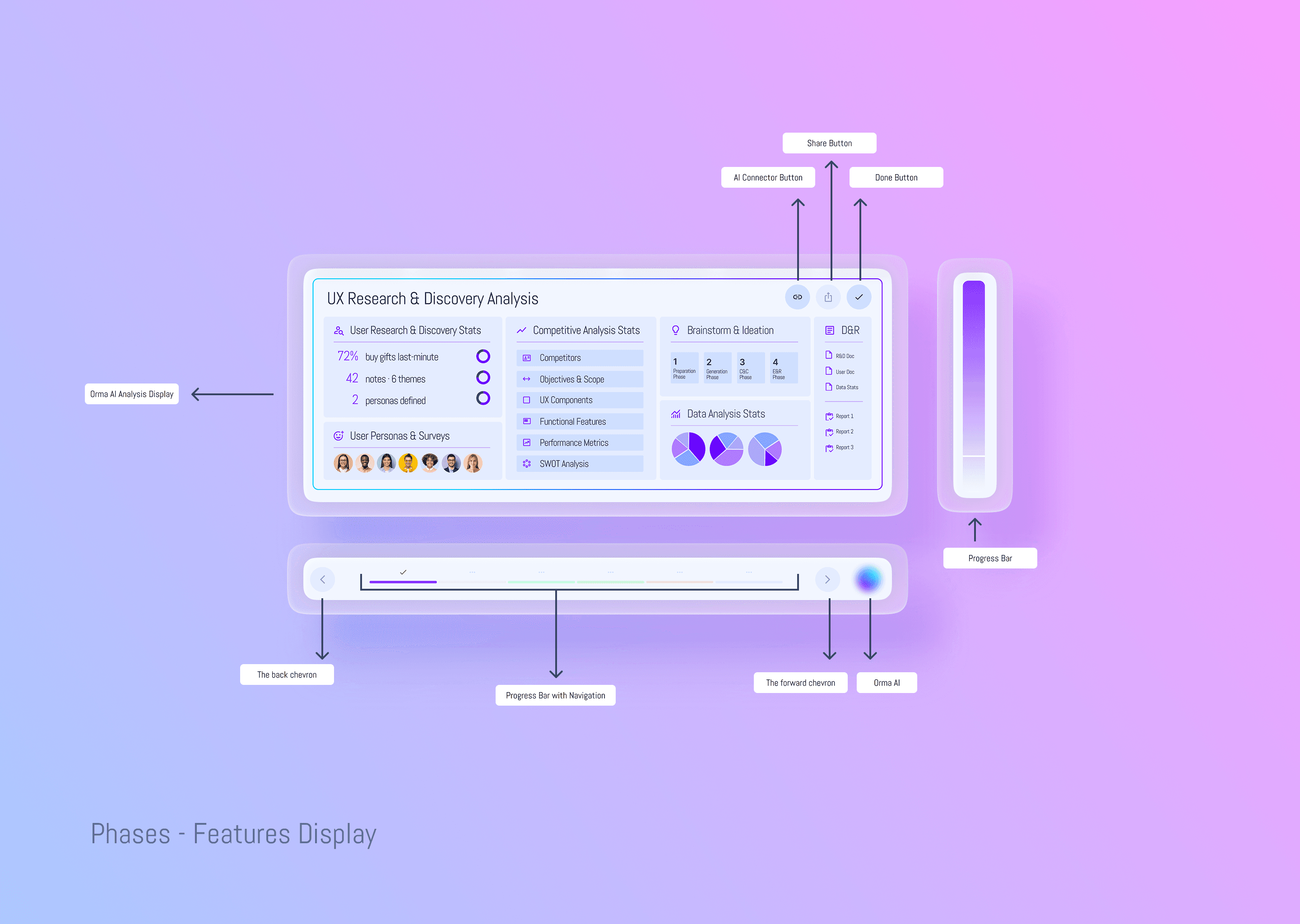
What every workspace shares. The Orma AI Analysis panel appears in every phase with the same three controls — AI connector, share, and done — and the bottom bar is the lifecycle itself: six segments in the six phase colors, showing every phase's progress at a glance, with back and forward chevrons beside it. It's progress display and navigation in one — tap any segment and you're in that phase, no moving around. Learn one workspace and you've learned all six; the interface changes its contents, never its rules. It's the handoff's predictability principle, applied to the screen.
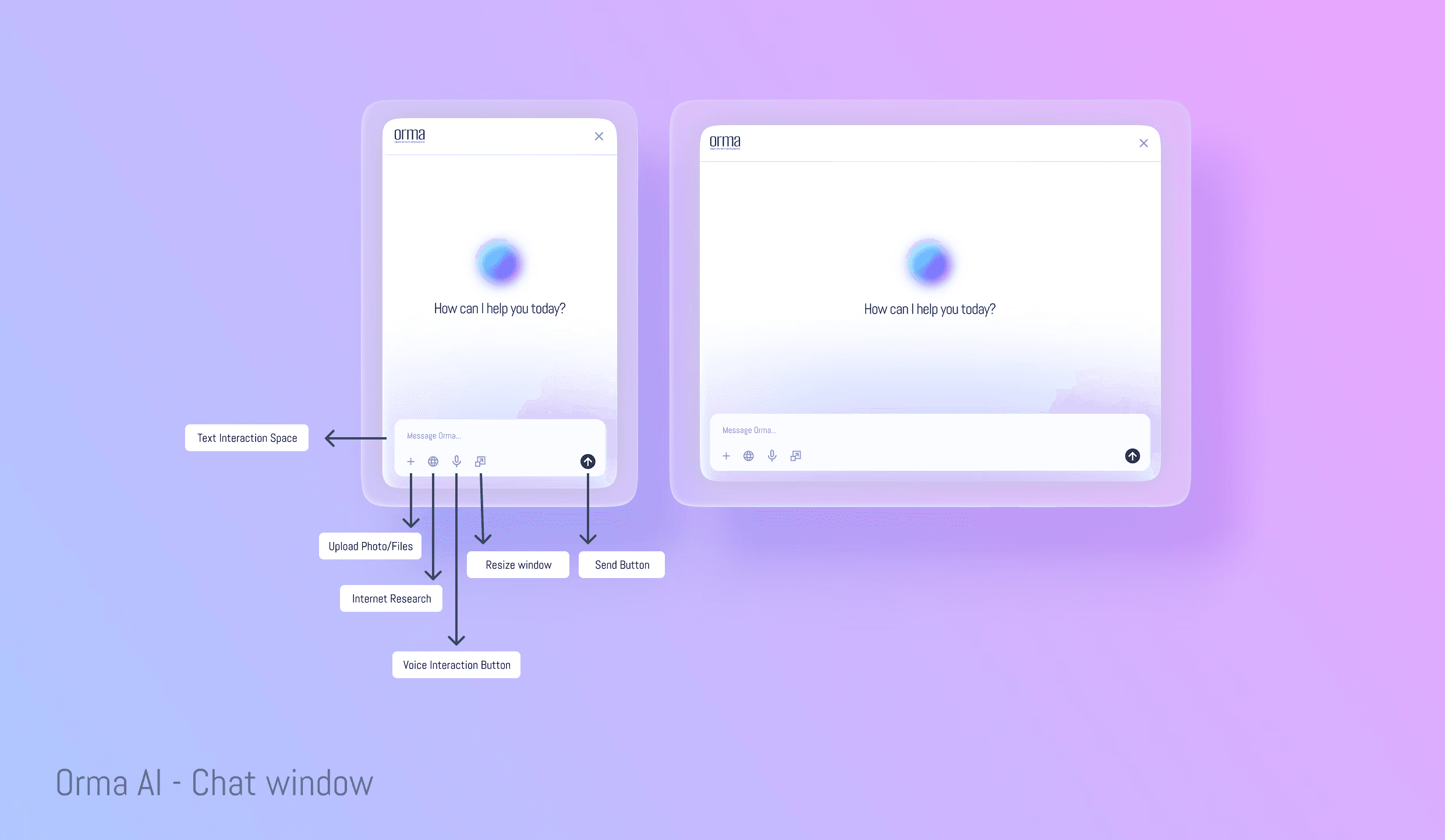
The orb opens Orma's single conversational surface — the same window in every phase, resizable from quick question to working session, taking text, voice, files, or a live web search. The designer always talks to one Orma. Behind the window, the orchestrator routes each request to the agent of the current phase — the user never manages agents, they just ask. One front door for the whole system.
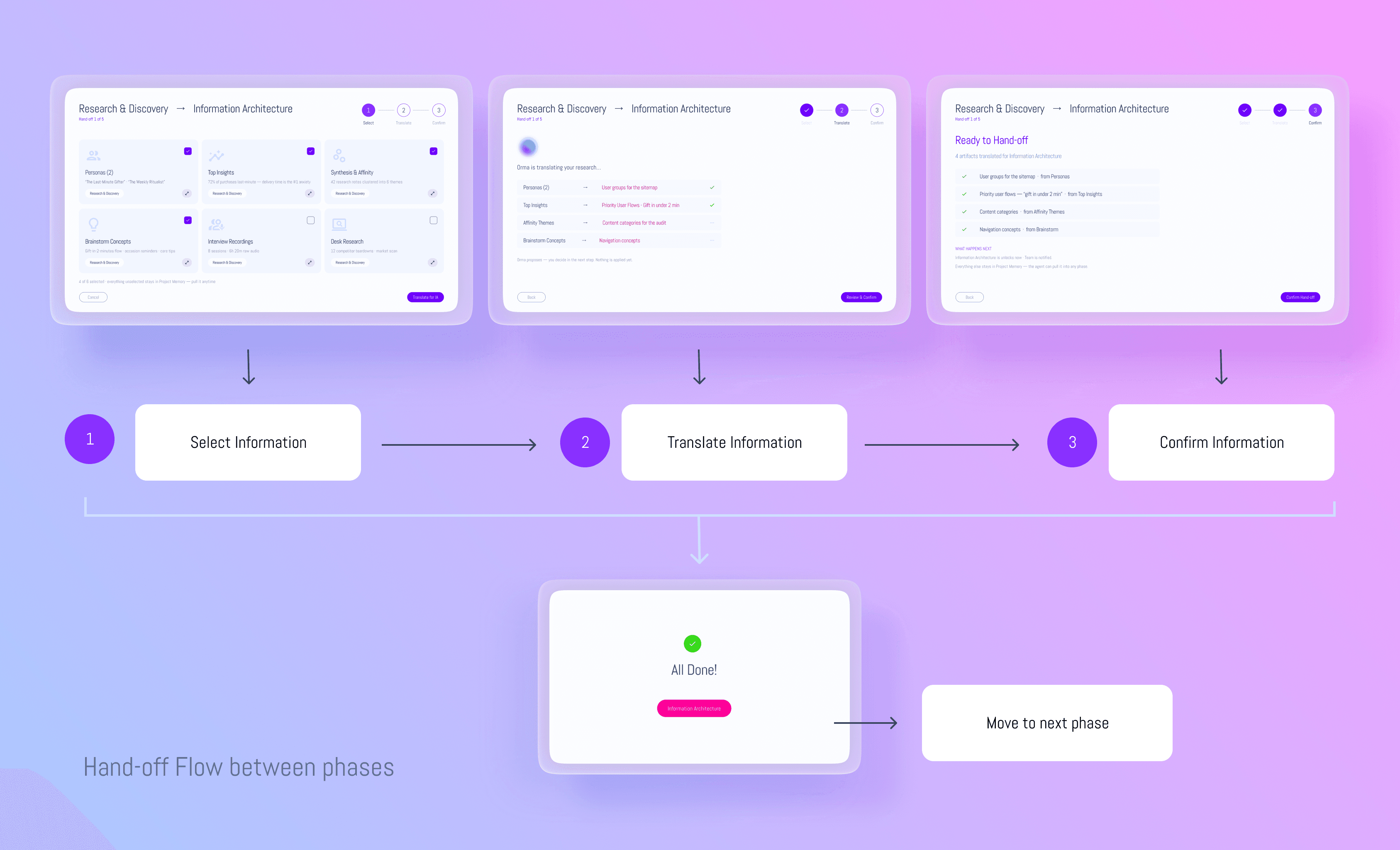
The pattern from the diagram, running for real: Research & Discovery hands off to Information Architecture — crossing one of five. The designer selects four of six artifacts; everything unselected stays in Project Memory, retrievable anytime. Orma translates each artifact into what the next phase needs — personas become user groups for the sitemap, top insights become priority user flows — proposed, not applied. On confirm, the work moves across, the team is notified, and traceability travels with every artifact. The other four crossings look exactly like this — which is the point.
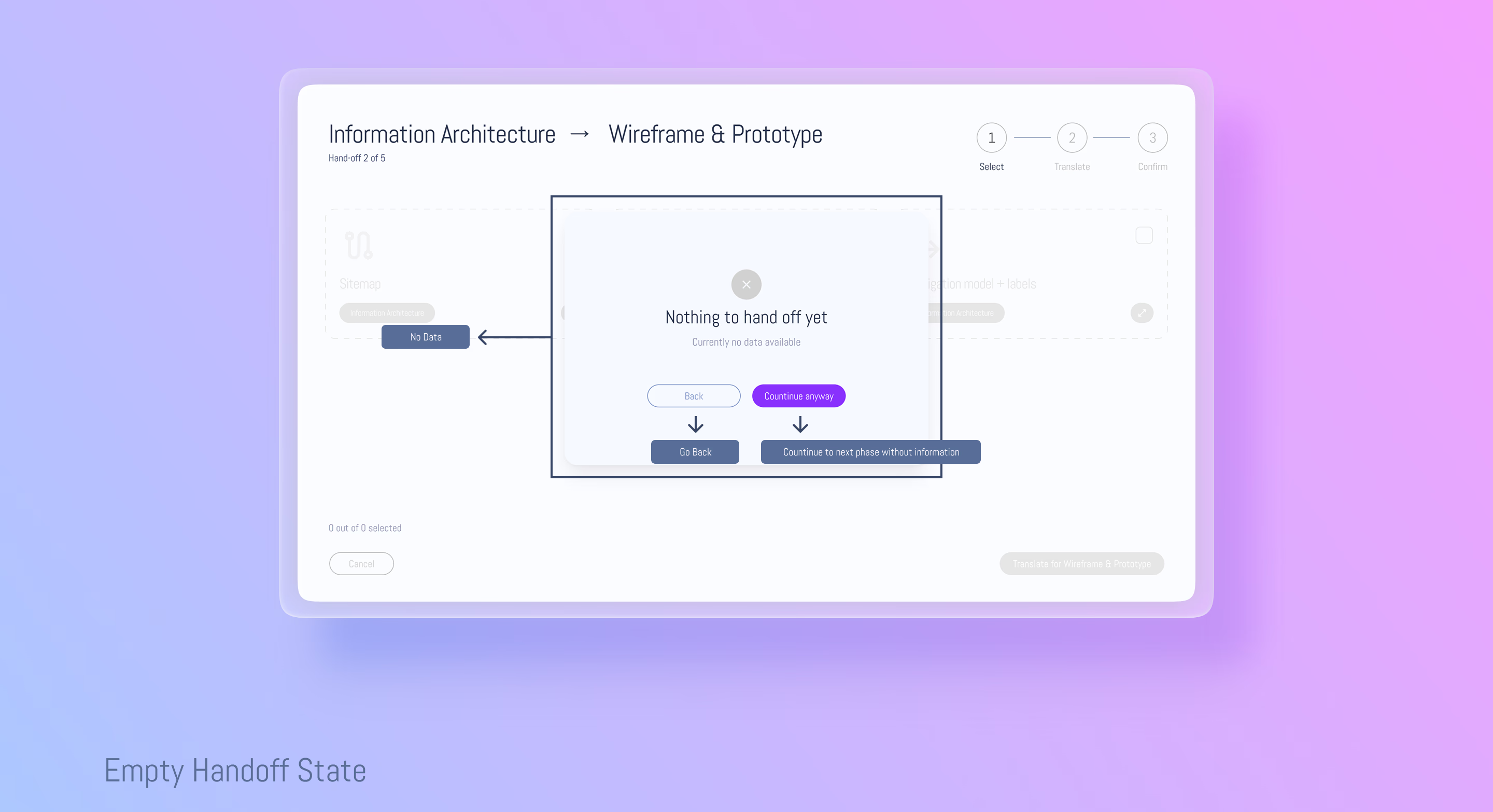
And when there's nothing to move, Orma says so. The empty handoff doesn't invent content and doesn't lock the door: the designer can go back and finish the missing work, or continue to the next phase deliberately, with nothing. Trust is decided at the edges — an AI that admits "no data" is an AI whose "four artifacts ready" you can believe.
Reflection
Orma is a conceptual prototype — designed and validated against research, not yet built or user-tested. The thesis evaluation named the real adoption challenges honestly: technical complexity, privacy of centralized project data, and the risk of over-reliance on AI.
What this project demonstrates: turning qualitative research into concrete product decisions — every feature traces back to an interview insight or a gap in the tool audit; systems thinking at platform scale; and designing for designers — balancing AI efficiency with the trust, control, and creative autonomy practitioners need.
category
User Experience - Speculative Concept M.A Thesis
Role
Solo
year
2024-2025
timeframe
6 months · 2024–2025 (4 months research & analysis, 2 months design & prototyping)
01

02

03

